WRITING FOR HARP
By Terry Dwyer
1. Understanding the harp
a) The basic sound
Of course everybody knows that harp strings are plucked with the fingers of both hands (incidentally the little fingers are not used), and the first thing to remember is that the resulting sound will die away in its own time – a fairly long time for the bass strings, and a very short time for the top ones. Unless, that is, the player damps them. He will, if and when he can spare a hand from playing, and clearly he will be more concerned to damp the bass strings – unless the composer marks the music laissez vibrer (let vibrate) or l.v. for short. In most orchestral situations we need not worry about this since the tails of harp notes are easily covered up by other instruments.
b) The basic scale
As we ascend the basic scale of a harp we encounter seven strings per octave, giving C D E F G A B and then repetitions of this sequence, exactly as on the white notes of the piano. For the moment, let’s pretend that’s all that’s possible because that’s how the harpist has tuned it. Sowhatever a composer gives the harpist to play, it would have to be in the key of C. Fine, plenty of music possible.But if we suddenly needed an F#, what happens? By the use of a pedal the harpist can switch his F strings to F#. Note well, ALL his F strings – he cannot move some up and not others. The same applies to the other notes of the scale; they can all be sharpened, or flattened, making it possible to play any pitch whatever. The essential thing to grasp is that each letter name of our C-B scale can only be in one form at a time. It’s always a seven-note scale, never a 12-note scale as on the piano. Read on.
c) The pedals
The harp has seven pedals, not easily visible unless you are close up. Not one of them is a sustaining pedal; the only dampers are the harpist’s hands, remember. Obviously there is one pedal for each note of the C major scale. Each pedal (please never say “foot pedal”) moves vertically in a specially stepped groove which enables it to stay in one of three positions: flat, natural, sharp (as we lower it). Changes can be made silently and reasonably quickly, but not so quickly that a chromatic scale would be anything but at a moderate pace. (Anyway, playing F followed by F# is not too pleasant as the pitch-changing mechanism strikes the buzzing string and tweaks the pitch up.) So what I am saying is that composers need to allow plenty of time for pitch-changes before the new notes are required, particularly if there are several to be made simultaneously.
We should now understand that at any one time the harp strings stand tuned in a particular set way, with ALL the C strings in one form, (probably natural), ALL the D strings in another, and so on. This may well be to accommodate the different key signatures required, but notice that the combination need not represent a key; we could have C, Db, Eb, F# G# Ab and B for example. Note also that unusual enharmonics are possible, such as B#, Cb, Fb.
One result of this tuning system is that in a glissando every string must be accounted for. No problem for a scalic glissando, but for a chordal one the composer has to do some thinking. More later.
d) False notation
Because many notes of the chromatic scale are available on either of two adjacent strings, it is sometimes advantageous to use the enharmonic equivalent of the real note desired.
Thus, a passage like this:
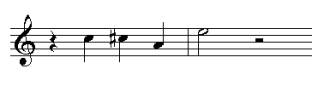
which would involve an undesirably hasty pedal change, would be better notated thus:
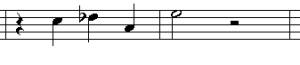
which is perfectly easy and sounds the same.
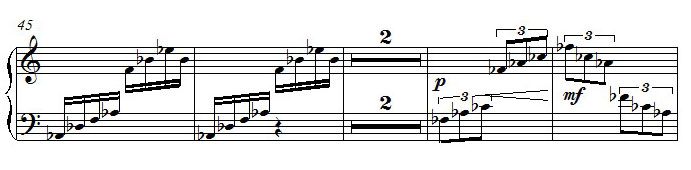
Another reason for notating “falsely” is that the harp strings sound at their best in the flat position, because the whole string can vibrate unencumbered by the tuning mechanism at the top. (Similar to the way an open violin string sounds different from a stopped one.) For that reason, music with a lot of sharps is better rewritten with a lot of flats, even though some of the chords may look weird. The harpist does not care what the music looks like; he simply plucks the strings indicated and trusts the pedals to look after the exact pitch.
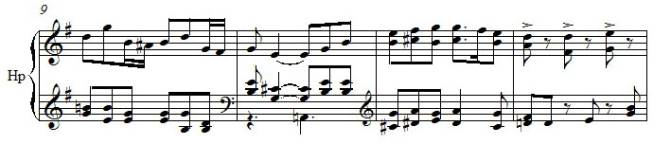
The next music example below is an example of this false notation in order to get a more resonant sound.The last two bars are actually an E major arpeggio.
2. Composing for the harp
What sort of music suits the harp?
Well, first and foremost, music which understands the limitations set out above. There are other limitations, too:
a) Lack of sustaining power. There is some length to the lowest notes, but generally you should not expect much sustaining, particularly in the treble register.So probably best to keep the part moving (except for detached chords, of course.)
b) What the player’s hands can stretch. This is probably more than you think. The harp strings being closer together than a piano’s naturals, the player, even without the little finger, can stretch a tenth easily. And each hand can catch up to four notes. Don’t think that you must space chords out in the left hand – close four-note chords don’t sound too muddy there, and since the harp is relatively weak in power, the more notes the better in many cases.
These aside, let’s think of some effective harp music:
a) Arpeggios. I’ll put these first
because after all, “arpeggio” means “like a harp”, and arpeggios will always
sound well on the harp. You’ll probably write in eighth or sixteenth notes for
this. Arpeggios can be short or quite extensive, covering two or three octaves.
In the latter case the player will use alternate hands to cover the extent of
it. You can write just one arpeggio to highlight a phrase, or repeated arpeggios
to form an accompaniment. Don’t overlook the potential of downward arpeggios.
b) Chords. It is normal for harpists to roll all chords
upwards (like a fast arpeggio, in fact). Two-handed chords can roll from lowest
note to highest, if you put an unbroken wavy line across the two staves, or in
both hands simultaneously, if you break the line in two. However, if you give
the left hand an octave with the rest of the chord in the right hand, the
player would not roll the left hand notes.
If you really want a chord to be played straight, put a straight bracket
before it, or mark it non arp.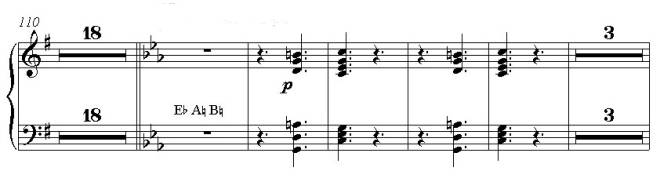
c) Any accompaniment pattern. Not only arpeggios, but any musical pattern whatever – passing notes, leaps etc.
Melody and accompaniment. Quite
possible. This would resemble piano music. In fact, whatever goes on the piano
goes for the harp, provided you remember the limitations. The player would bring
out the melody above the accompaniment, by plucking at different strengths.
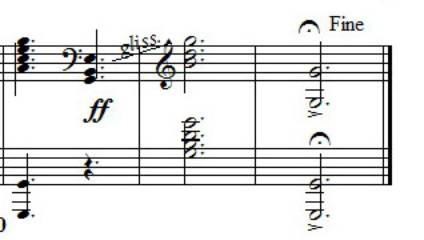
e) Glissando. I’ve put this last because, as orchestration books will warn you, the harp glissando is orchestration’s most over-worked cliché. So use it as sparingly as you can bring yourself; it soon palls on the listener’s ear if overdone. Again, don’t overlook the downward glissando – but try not to use too much “Hollywood” up-down-up-down-up-down continuous stuff.A short, quiet glissando can be magic in the right setting.
There are snags in glissandi, bearing in mind that as the player sweeps up the strings, every string must sound. Scales are no problem, except perhaps the whole-tone scale, which must be tunedC D E F# G# Ab Bb, or C# D# E# F G A B. Nobody notices the duplications in performance. Chords are harder: the dim 7th is OK with C# Db E Fb G A# Bb, and so on, but for a chord like G7 we can use G B Cb D E# F but what are we going to do with the A? The answer is we have to play it and put up with the foreign note. Of course we could always use a big arpeggio instead.
Finally, remember that glissandi need not be one note at a time. Octaves between the hands are good, even octaves in each hand, or chords in each hand. If there is much competition from the orchestra, these extra notes become very necessary to make the instrument heard.
Normal uses in the orchestra, apart from glissandi
Boosting the harmony, with
chords or arpeggios. Fine, but don’t make it incessant – the sound palls with
overuse. Many composers omit the harp in fortissimo tuttis as it would probably
not be heard anyway.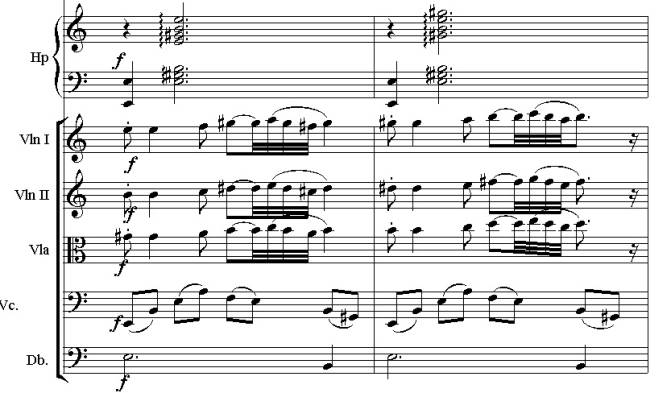
b) Doubling other instruments. The harp can reinforce string pizzicatos, double the clarinet to give an imitation piano, double the bass instruments to give greater definition, double anything really.
c) Accompanying a solo instrument. A well-established partnership is with the flute. These two very different instruments really do sound gorgeous together. But other quiet instruments are good, perhaps a solo violin.
d) A harp solo. You may well find you want to do this sometime. But nothing so elaborate and time-spinning as the introduction to Tchaikovsky’s Valse des Fleurs, please!
e) Don’t over-use the harp. The less it is used, the more effective when it does appear. Use it when you feel the need for its particular colour. A harp part should usually have more bars resting than playing.
Special effects
a) Harmonics. Produced by
stopping a string at its halfway point with another part of the hand whilst
plucking it with the finger. The resulting sound is magical and fluty , and an
octave higher than the normal string. Write a ° over each note, allow for it to sound an octave higher, and don’t make
the music too fast. The sound is far from loud, so put it in a quiet context.
It can be used to double other sounds, e.g. low flute. It also sounds good in
combination with the celesta. Remember that it is best in the middle register
of the instrument.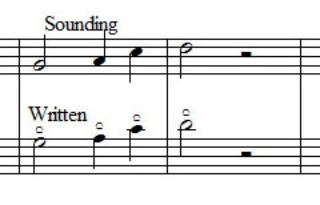
b) Pres de la table (=”near the soundboard”) Strings plucked here rather than in the middle of the string as normal will sound higher harmonics and so more steely, brighter. Best in top area.
c) Tremolo. Rapid repetitions on the same string are perilous, even with alternating hands, as the finger tries to catch a still moving string. The way to do this is by alternating two strings tuned to the same enharmonic pitch, e.g. D# and Eb. This is not possible on the notes D, G and A – I’m sure you can work out why. Of course when you input a tremolo on your keyboard you will have to repeat the same note.
d) Doubling at same pitch. To fortify a single note, play the enharmonic simultaneously on the next string. This is especially effective when reinforcing the bass.
e) Two harps were often used by French composers. One reason is to fortify the weak sound, the other to make quick chromatic changes possible by switching to the other harp which had already prepared its settings.
Notating for the harp
That last remark reminds me to advise you what to do if you are preparing a score for live performance. Of course harp parts are written on two staves, normally treble and bass, just like the piano. But before every passage, you must indicate to the player which pitch-classes need setting to anything but naturals.Thus a piece in Eb major would start the harp part off with the Eb key signature: that should be enough, but if the Eb passage suddenly occurred during a piece in C, then the following should appear in the harp part (between the staves): Eb, Ab, Bb. If during the passage a C# is needed, then put “C#” in the bar requiring it.And so on. To summarise, all pitch changes should be indicated: a) a bar or two in advance, if the harp is resting; b) over the actual note or immediately before it, if the harp is already playing.
To
notate a glissando, carefully indicate the exact pitch of the starting and
ending notes, also their rhythmic placings, then a straight line between them
bearing the word gliss(ando) will suffice, provided that you have
indicated the required pitch changes beforehand.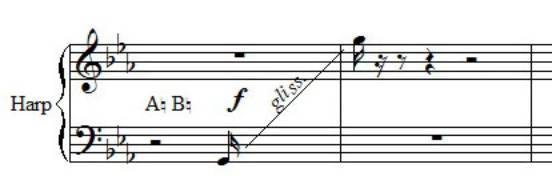
Have the following terms ready for use at all times: non arp, laissez vibrer, sec or etouffez (= damp quickly), pres de la table, bisbigliando (I’ll let you look that one up – why should I do all the work?)
Lastly, study the harp parts in orchestral scores by Debussy, Ravel and Stravinsky. If you can get a copy of Britten’s A Ceremony of Carols, the harp part, which is the sole accompaniment, is very instructive, especially the central Interlude. Another wonderful part to study is Ravel’s Introduction and Allegro, though it does call for quite a skilled player.
Now you are all set to make wonderful harp music. Enjoy!
Terry Dwyer
October 2004